Anton Haus
Legacies of mariners
Maritime Museum of Piran
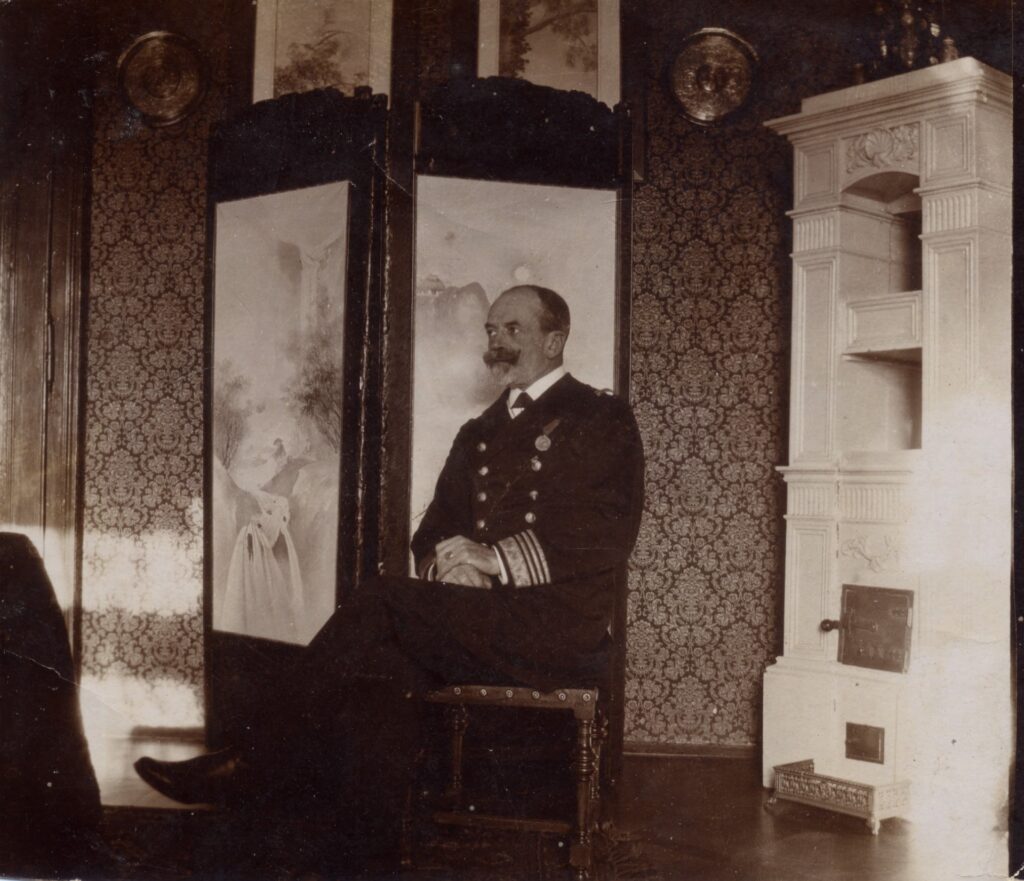
Anton Haus (Tolmin 1851–Pula 1917), who rose to the highest rank—of Grand Admiral—in the Austro-Hungarian Navy, was Commander-in-Chief of the Navy from February 1913 until his death. He initially attended school in Novo Mesto, where his family had moved during his childhood, and completed the last three years of classical secondary school in Ljubljana. He then joined the navy as a provisional naval cadet in Trieste, where he quickly rose through the ranks.
In 1900, Anton Haus was assigned command of the corvette Donau, with which he was to sail to South America. From there, due to the Boxer Rebellion in China, the ship was sent to East Asia. Upon arrival in Nagasaki, Haus became captain of the armoured cruiser Kaiserin und Königin Maria Theresia with a crew of 475, and soon afterwards, in 1901, commander of the entire East Asian Squadron. By the time of his arrival, however, the conflicts had already ended. In addition to coastal cities and towns along the Yangtze River, he also visited Beijing, Tokyo and several other places in East Asia, to which he travelled by train. In Korea, he was hosted by the Korean emperor at the court in Seoul. He returned to his homeland by passenger ship in January 1902.
Anton Haus brought back several objects from East Asia, including pieces of furniture. He bought them not only for himself and his immediate family, but also for other relatives. Anton Haus married his cousin Ana Trenz from the Draškovec mansion near Šentjernej, which he often visited both as a child and after his marriage. The heirs of the Trenz family in Šentjernej therefore preserved a Japanese screen and fan, which were purchased by the Maritime Museum Piran in 2018.